


What Documents Should You Check Before Buying Property in Italy?

A beautiful view can make a property feel right in five minutes. The paperwork tells you whether it actually is.
In Italy, property purchases are document-heavy for a good reason. The notary checks the legal transfer, but the buyer still needs to understand what’s being checked, what can go wrong, and which papers deserve a closer look before signing anything. This is especially true if the property is old, renovated, rural, inherited, part of a condominium, or near a lake or coastline.
This guide is informational only and isn’t a substitute for legal advice. A qualified Italian notary, surveyor, and independent lawyer can check the details for the specific property.

Start with the big picture
Before getting into single documents, it helps to know who does what.
In Italy, the notary is a public official who prepares or receives the final deed of sale and carries out legal checks on ownership, registration, and certain tax matters. The notary must be impartial, not “your” lawyer or the seller’s lawyer.
A surveyor, architect, or engineer usually checks planning, building compliance, boundaries, floor plans, and the physical state of the property. An independent lawyer can review contracts, deposits, inheritance issues, and special conditions, particularly where the buyer doesn’t speak Italian fluently.
When people search for documents buying property Italy, they’re usually trying to answer one question: “Can I safely buy this property without hidden legal, planning, or ownership problems?” The documents below help answer that.
The key documents to check before you buy
Here’s a practical overview of the main papers to request and review.
Document | What it tells you | Why it matters |
Title deed | How the seller acquired the property | Confirms the seller’s right to sell |
Land registry information | Property identifiers, ownership records, boundaries, and registered burdens | Helps reveal mismatches, loans, rights of way, or other claims |
Planning permissions | Whether the building and works were authorised | Unauthorised works can delay or block a sale |
Floor plans | Whether the actual layout matches official records | Differences may need correction before completion |
Energy performance certificate | The property’s energy rating | Required for most sales and useful for running cost expectations |
Certificate of usability | Whether the property meets basic usability standards | Important for habitability, renovations, and future resale |
Condominium documents | Shared costs, rules, and debts | Essential for flats or properties in shared buildings |
Tax and payment documents | Local taxes, service charges, and payment history | Helps avoid unpaid amounts becoming a dispute |
Pre-contract documents | Deposit terms, deadlines, conditions, and penalties | Once signed, the preliminary contract can be binding |
Title deeds show whether the seller can sell
The title deed is one of the first documents to ask for. In Italian, it’s often called the `atto di provenienza`, which means the deed showing where the seller’s ownership comes from.
This might be:
A previous purchase deed
An inheritance declaration
A gift deed
A court order
A division of family property
The title deed should show the owner’s name, the property description, the purchase date, and any relevant conditions. It should also link clearly to the property being sold.
Why it matters
If the seller inherited the property, several family members may have rights. If the seller received it as a gift, future inheritance claims can sometimes create complications. If the property was bought by a married couple, marital property rules may affect who needs to sign.
These issues don’t always stop a purchase, but they need to be understood before money changes hands.
How to verify it
Ask for a copy of the seller’s title deed early. Then have the notary or your lawyer cross-check it against the public property registers. Names, tax codes, property identifiers, and ownership shares should match.
Don’t rely only on a scan sent by email. The notary can obtain official records directly from the relevant public registers.
Land registry information can reveal hidden problems
Italy has more than one type of property record, and this can confuse foreign buyers.
The land and buildings register, often called the `Catasto`, records property identification details, category, class, size, map references, and a value used for some tax calculations. It’s useful, but on its own it doesn’t prove legal ownership.
The public property registers record legal transfers, mortgages, restrictions, and other formal entries linked to the property.
Both sets of records matter.

What to check
Look for:
The owner’s full details
The property address
Map sheet, parcel number, and sub-number where relevant
Property category and use
Registered mortgages or loans
Rights of way
Easements, such as access, drainage, or utility rights
Seizures, court claims, or other restrictions
Boundary or parcel inconsistencies
A rural house, for example, may come with land, access roads, outbuildings, wells, or shared tracks. Those details need to appear correctly in the records. A lakefront or hillside property may have access or boundary issues that aren’t obvious during a viewing.
How to verify it
Ask the notary to obtain up-to-date official searches. If there’s land involved, ask a local surveyor to compare the map records with the actual site. Physical boundaries, old fences, stone walls, or tracks don’t always match the registered plan.
A simple tip is to compare three things side by side:
The title deed
The land and buildings register extract
The actual property and floor plan
If the same property appears differently in each place, pause and ask why.
Planning permissions show whether the building is legal
This is one of the biggest checks when buying property in Italy, especially with older homes, renovated houses, and properties in protected areas.
Planning documents show whether the building was approved by the local municipality and whether later works were authorised. These records sit with the local council, known as the `Comune`.
Depending on the property, relevant files may include:
Original building permits
Later permissions for extensions or changes
Renovation authorisations
Documents regularising past unauthorised works
Landscape or heritage permissions where required
Structural filings in areas with earthquake rules
Why it matters
A property can look finished and still have planning issues. An attic may have been turned into a bedroom without approval. A terrace may have been enclosed. A basement may be used as living space even though it was approved as storage.
These differences can affect the sale, mortgage approval, insurance, future renovations, and resale value. In some cases, problems can be corrected before completion. In others, they may not be fixable.
How to verify it
Ask a local surveyor, architect, or engineer to carry out planning checks at the municipality. They should compare the approved plans with the current state of the building.
Don’t accept “it has always been like this” as proof. In Italy, long-standing use doesn’t automatically make a change legal.
Ask for a written technical report if there are doubts. That report should explain whether the property matches the approved records and what, if anything, needs to be corrected before the final deed.
Floor plans must match the real layout
The official floor plan is usually filed with the land and buildings register. It shows the layout of the property, including rooms, internal walls, entrances, terraces, cellars, and sometimes garages or storage areas.
Why it matters
At completion, sellers are generally expected to confirm that the registered floor plan matches the real property. If a kitchen has moved, a bathroom has been added, or internal walls have changed, the records may need updating.
Small differences can be simple to fix. Bigger differences may point to unauthorised building work.
How to verify it
Walk through the property with the official floor plan in hand. Check:
Number of rooms
Position of bathrooms and kitchens
Windows and doors
Terraces, balconies, and verandas
Cellars, garages, and storage spaces
Staircases and entrances
If the plan doesn’t match, ask whether the mismatch is only a registry update issue or a planning permission issue. Those are not the same thing.
The energy performance certificate is required for most sales
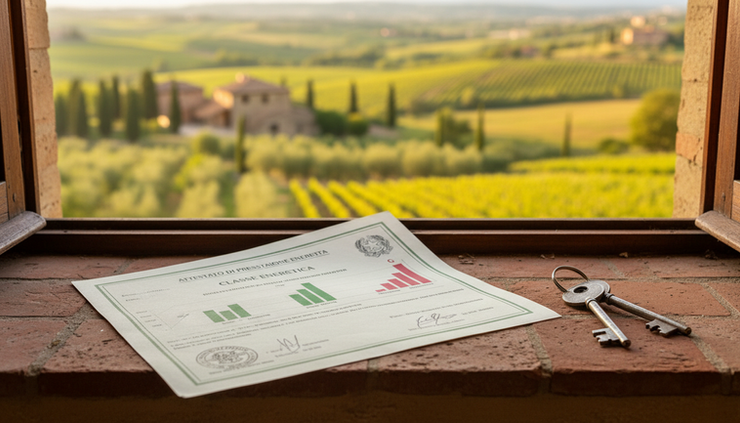
The energy performance certificate, known in Italian as the `Attestato di Prestazione Energetica`, gives the property an energy rating. It also includes information about heating, cooling, insulation, and suggested improvements.
Italian law requires this certificate for most property sales and rentals. It must usually be available before completion, and the energy rating often appears in sale documents.
Why it matters
The certificate won’t tell you everything about comfort, but it gives a useful snapshot. A stone farmhouse with single glazing and an old boiler may cost more to heat than a newer flat with better insulation. If the plan is to live there year-round, this matters.
The certificate also helps avoid last-minute delays, because missing sale documents can slow the notary process.
How to verify it
Check that the certificate:
Refers to the correct property
Has the correct address and property identifiers
Was prepared by a qualified technician
Is still valid
Matches what you see in the property, such as heating type and systems
If the property has been renovated after the certificate was issued, ask whether a new certificate is needed.
The certificate of usability can affect how the property is used
The certificate of usability, often called `agibilità`, relates to whether a building meets basic standards for use, such as safety, hygiene, and systems compliance. The rules and history around this document can vary according to the age of the property and local practice.
Why it matters
Lack of a usability certificate doesn’t always mean a property can’t be sold. Older properties may have incomplete records. Still, it can matter for renovations, mortgages, future resale, and peace of mind.
If a property is advertised as ready to live in, it’s fair to ask whether there is evidence supporting that.
How to verify it
Ask the seller for the certificate or the related filing documents. If none exist, ask a technician to explain the reason and the practical risk.
For a newly built or heavily renovated property, expect the paperwork to be clearer. For an old village house, the answer may be more nuanced, but it should still be checked.
Condominium documents matter if there are shared areas
If the property is an apartment or part of a building with shared areas, ask for condominium documents before signing a binding contract.
These may include:
Condominium rules
Recent meeting minutes
Annual accounts
Budget for future works
Confirmation of seller’s unpaid charges
Details of planned repairs
Rules on short lets, pets, parking, or building use
Why it matters
A cheap apartment can become expensive if the building has approved major roof works, façade repairs, or lift replacement. In many shared buildings, rules also affect how the property can be used.
How to verify it
Ask the seller or building administrator for recent documents. Have your lawyer check whether any major works have already been approved, because payment responsibility can depend on timing and contract wording.
The preliminary contract needs serious attention
Many buyers sign a preliminary contract before the final deed. This is often called a `compromesso` or `contratto preliminare`.
It usually sets out:
Purchase price
Deposit amount
Completion deadline
Property description
Conditions to be met before completion
What happens if either side pulls out
Fixtures and fittings included in the sale
Why it matters
This contract can be binding. In many cases, if the buyer withdraws without a valid reason, the deposit may be lost. If the seller withdraws, they may have to return more than the deposit, depending on how the contract is written.
How to verify it
Don’t sign a preliminary contract in a language you don’t fully understand without independent advice. Ask for a bilingual version or a proper translation. Make sure any conditions are written into the contract, not just agreed in messages.
Useful conditions might include:
Satisfactory planning checks
Mortgage approval if needed
Confirmation that floor plans match
Removal of registered loans or restrictions before completion
Delivery of condominium documents
A practical checklist before signing
Use this as a working list before paying a large deposit.
Check | Who usually helps |
Seller’s ownership and title deed | Notary or lawyer |
Public property register searches | Notary |
Land and buildings register extract | Notary or surveyor |
Floor plan comparison | Surveyor, architect, or engineer |
Planning permission review | Surveyor, architect, or engineer |
Energy performance certificate | Qualified technician |
Usability certificate review | Surveyor, architect, or engineer |
Condominium debts and rules | Lawyer and building administrator |
Preliminary contract review | Lawyer |
Translation of key documents | Qualified translator |
One plain rule helps: never let the viewing move faster than the paperwork.

How to spot documents that need extra checks
Most issues are found through normal due diligence, but a few signs should slow things down.
Watch for:
The seller can’t provide the title deed
The names on documents don’t match
A property has visible renovations but no related permissions
The floor plan is clearly different from the real layout
Land boundaries are described vaguely
The energy certificate has the wrong address
The seller pushes for a quick deposit before checks
Condominium accounts are missing or unclear
Part of the property is described as “not officially included”
If something feels unclear, ask for the explanation in writing. A serious seller should be able to provide documents or allow the professionals time to obtain them.
FAQ
Can a foreign buyer get official property documents in Italy?
Yes. The notary and appointed professionals can obtain official searches and copies from the relevant public offices. Some records are easier to access than others, but buyers don’t have to rely only on seller-provided scans.
Is the land and buildings register proof of ownership?
No. It’s useful for identifying and classifying the property, but legal ownership is confirmed through the public property registers and the chain of title deeds.
Should I sign a preliminary contract before all checks are complete?
It’s safer to complete key checks first. If timing makes that difficult, the contract should include clear conditions that protect the buyer if serious legal, planning, or mortgage issues appear.
What if the floor plan doesn’t match the property?
Ask a qualified technician to identify the reason. It may be a simple registry update, or it may point to unauthorised building work. The difference matters.
Is an energy performance certificate enough to judge running costs?
No. It’s a useful guide, but it’s not a full survey. Heating type, insulation, window quality, altitude, exposure, and personal use all affect real costs.
Take your time before you transfer money
The right documents won’t make a poor property good, but they can stop a promising purchase from becoming an expensive problem. Before committing, check ownership, registry records, planning history, floor plans, energy performance, usability, and shared building obligations.
If the property is in an area you love and the paperwork is clean, the process becomes much less stressful. If you’re still comparing homes, you can start with available real estate in Italy and keep this document checklist beside you as you review each option.
The best purchase isn’t the one that moves fastest. It’s the one where the house, the records, and the legal position all tell the same story.

Comments